


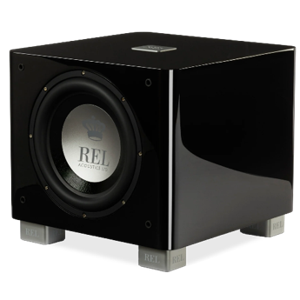
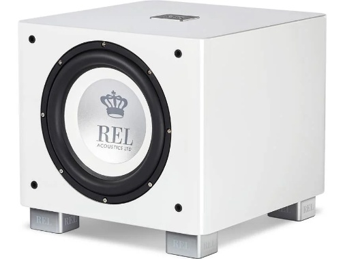
REL Acoustics have been making subwoofers since 1990 and they only make subwoofers – that checks a box for me. Focusing solely on subwoofers, or bass-engines as REL describes them, confirms this product is well thought out and not simply an off-the shelf design. REL is a British manufacturer offering six subwoofer lines. The T/9X reviewed here sits in the middle below their top-of-the-line Reference Series and Serie S. Three colors are available for $1,699 black, white, or grey, all in a gloss lacquer finish. REL recently launched the T/9X SE for $1,799 which offers a carbon fiber cone and five color options: lemon yellow, tangerine dream, green with envy, French racing blue, and Italian racing red – also in a gloss lacquer finish.
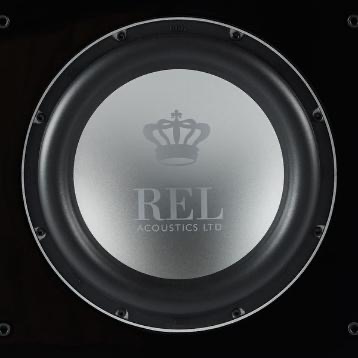
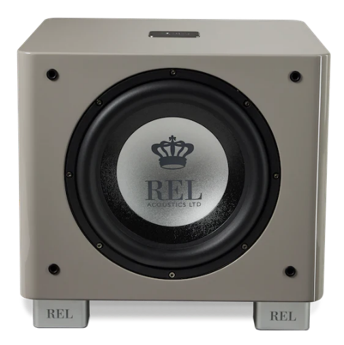
REL’s T/9X is a solidly built box with a 10” front firing subwoofer, proudly displaying the Queen’s crown above their logo. This subwoofer wants you to know it’s British. I am smitten by this sub’s appearance. A 300-watt class A/B internal amplifier powers the 10” sub with musical force. The subwoofer has another down-firing passive radiator acting as a port, and as expected, there’s a logo in the center of the cone. The handsome box sits on four sturdy aluminum feet large enough for REL to throw a logo on each one. While some may argue it’s too many logos, not here.
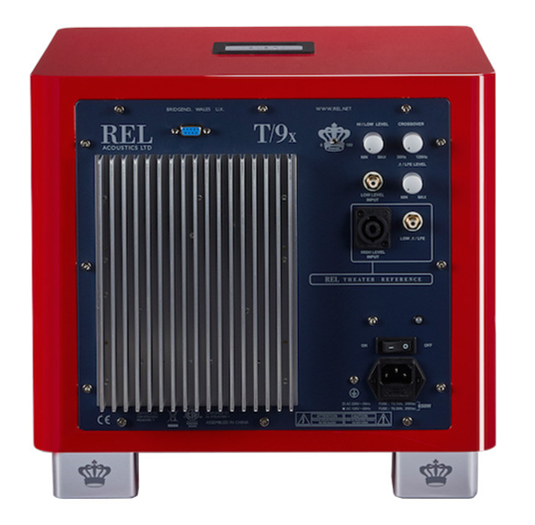
The internal amplifier is on the rear panel and accepts three different inputs. First is the hi-level Neutrik speakon, their signature. REL provides a long Neutrik speakon cord which connects the subwoofer directly to your amplifier’s speaker binding posts. Yes, that’s in addition to your speakers. It’s a smart idea because it means your REL subwoofer is getting the same signal as your speaker. Whatever sonic flavor your amplifier is producing will be shared across all your transducers. Typically, an RCA is connected to your pre-amplifier’s subwoofer output then to the sub. The REL offers the same low-level connection as well as an LFE. Each connection has its own crossover and volume level. I like the thought of my subwoofer seeing the same signal as my loudspeakers. REL also offers a wireless solution via their Arrow Wireless product for an additional $250.
Setup
For this review I’m using the supplied hi-level cable connected to my amplifier speaker terminals. Since I am using a pair for T/9Xs, I connected one sub to the left channel positive leads and the second to the right channels. For placement, I have both subs in a stacked formation on the left wall midway between the loudspeakers and my seating position. I found that worked best in my room. You’ll have to determine what works best in your room, but feel free to put your sub stack in one of the front corners of your room. Usually that provides the most bass. I’d always recommend buying a pair of subwoofers as it makes placement easier and it sounds smooth and powerful with no strain. I don’t want my gear to work too hard. Pushing your gear at or above its limits always sounds harsh and unpleasant.
The pair of REL T/9Xs are connected to my Parasound A21+ power amplifier terminals in addition to the Klipsch Heresy III speakers sitting off the floor on 12” stands. My Mytek Brooklyn Bridge will be providing music via Qobuz steaming service. On their own, the Heresy’s naturally play down to around 50 hertz, so I used the crossovers on the RELs to play everything below 60 hertz. The gain on the rear of the RELs was set to 9 o’clock on the dial.
Listening to Music
Bass Room by Nenad Vasilic
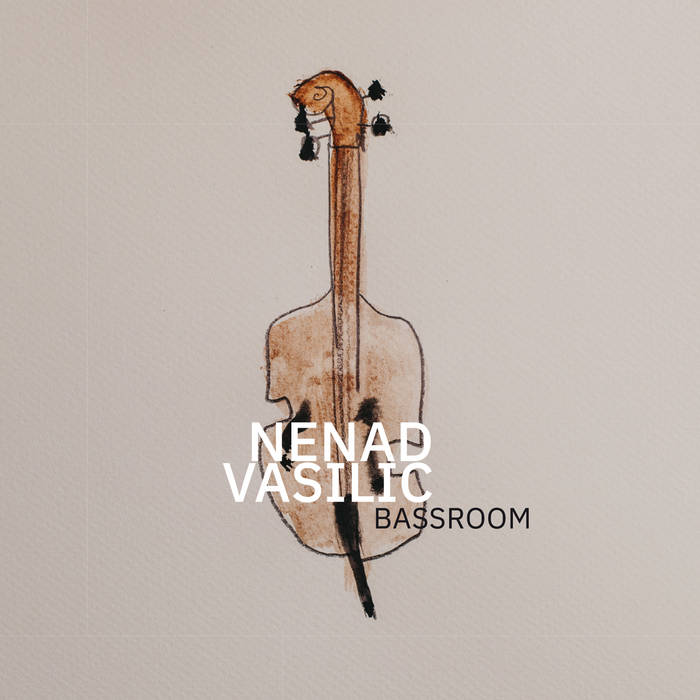
I let the REL’s break-in by playing pink noise overnight. Once I felt the subwoofers had settled in, I spent the next day playing music. During this time, I listened casually and did my daily chores checking on the system throughout the day. Standing in the kitchen, 25 feet from my listening room, as Nenad Vasilic’s release of his double bass solo album Bass Room, I felt a satisfying low-end detail I don’t remember ever hearing in my system. I dropped what I was doing and whisked towards my shrine to see what was happening. As the song Bass Drops began, Nenad’s plucking at his double bass had me in awe. The RELs provided levels to the lower frequencies I didn’t expect. Each pluck of the double bass left a subtle floor vibration that completely captured me. The vibration I felt wasn’t the overwhelming boom or rumble that takes over the music, rather an accurate view into the song. Nothing else vibrated because it was that pleasing accurate bottom end we all crave in this hobby. Nenad was in my room plucking away. This exceptional recording drew me into the music as I heard each movement of the double bass’s strings and felt them as they moved though the lower registers.
Queen Mary by Francine Thirteen

Francine Thirteen’s song Queen Mary is more of a sound effects track that I use to evaluate my system’s ability to produce sub 30 hertz information. I also use this song to identify any unwanted room rattles I need to remove. At the 25 second mark, a 30 hertz bass drop comes in, if your system is truly full range, you will be holding on for dear life because this feels like a 9.0 earthquake is rolling through your room. As expected, the two RELs produced the notes clearly with force. It’s literally like a huge rumbling boom that will shed a light on your system’s ability to provide deep bass. I love my Klipsch Heresy’s and thought they’d give me 75% of what the RELs were dishing out. The Heresy’s are a three-way horn-loaded speaker with a 12” bass driver and I wanted to test them on this track. I restarted the song with the RELs out of the system and sat back waiting for the sonic boom. I didn’t hear it so I checked the time on the track assuming there was still time before the 25 second mark and I was already at 40 seconds and no boom. Just a mild mid bass tap. To be fair these Klipsch aren’t designed to play much below 50 hertz, so I slid in my Monitor Audio Silver 8 2.5-way tower speakers, rated to play down to 32 hertz, into my system. At the 25 second mark the boom returned with far less weight and impact. With the T/9s in the system it’s a good and fun song I found myself playing several times and without the RELs it becomes a test track I’d shut down after the second bass drop.
One by Metallica
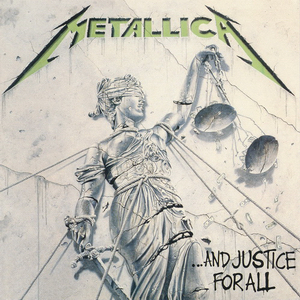
Metallica’s “One” from the And Justice for All album is one of my favorite songs and my go-to for evaluating how well the subwoofers integrate with my main speakers. At the 50 second mark Lars Ulrich’s drum kit should enter the room with a slam. The slam should be small, smooth, and neither the subwoofer nor the main speakers should stand out. I’m looking for a cohesive picture, unnoticed transitions throughout the frequency range. With the RELs handling all the information below 60 hertz and the Klipsch Heresy’s everything else, Lars’ kickdrum was as complete as I ever heard in my room. In many systems this part of the song will have that slam, but the Klipsch/REL partnership has slam with tone. I could easily identify all the details in Lars’ drum kit. Even after listening to this song for over three decades, I still get goosebumps over the right system. This combo had my arm hair standing at attention. Of course this song should be played at a minimum of 90 decibels and that’s the Klipsch’s comfort zone. Shortly after the kick drums startle you, Lars’ snare hit should sound like something is about to break, so clean so lifelike. I installed a killer sound system in my Subaru and use this song to demonstrate to my friends. When Lars hits those snare drums, it sounds like my dashboard is about to break. With the Klipsch/REL combination the snare’s crack was so lifelike. My car system provides me with sound pressure most home systems can’t match. With the Klipsch and RELs in my system I was getting that in spades. I didn’t anticipate the sound pressure, but this system delivered.
Pillar 1 by Andy Akiho
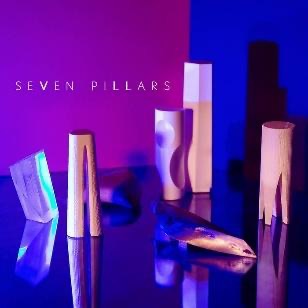
Andy Akiho’s Seven Pillars album is well recorded and is mostly a sound effects type recording. The first track, Pillar 1, will test your system’s ability to keep it together, especially in the lower frequencies. There’s an immediate boom that should move the room. If your system can produce very low bass, it’ll feel like the room is shifting off the foundation. I’m sure many subs can play in this arena and can put a smile on your face but we’re going after jaw-dropping sonics here. But there’s levels to this game. The sheer impact of the first bass drop was so loud and tight with the RELs I sat there in a jaw-dropped position for about 30 seconds. Again, the RELs produced deep bass with such authority and tone.
Final Thoughts
I own two other subs, KEF KC62 ($1,700) and an SVS 3000 Micro ($1,000). Both have dual subs KEF uses 2 6” drivers in tiny, rounded box and the SVS has dual 9” drivers. In both cases, the subs are firing in the opposite direction, aimed at eliminating box resonance. The KEF has an internal 1,000-watt amplifier. The SVS doesn’t provide wattage. Neither subwoofer can match the RELs tightness, deep bass extension, and especially tone. The fact that the RELs can deliver high levels on impact while maintaining audiophile levels of tone set them apart among the sub $2,000 subwoofer market. In all my listening experience I have never had a subwoofer contribute audiophile sonics to my system the way the T/9X’s do. The REL Acoustics T/9X subwoofers complete my system so ideally, I purchased the pair.
Our recommendations reflect our personal experience with the equipment reviewed and should be considered alongside your own listening preferences and room acoustics. We encourage readers to audition audio equipment whenever possible. Great sound is personal, and the best component is the one that brings you closer to your music.
