


When choosing audio gear for my own use, I almost always stick to well-established companies which continue to manufacture and innovate. I can only think of a handful of successful speaker manufacturers that made a substantial mark on the industry and continue to thrive today. KEF is among that short list and arguably the leader. Raymond Cooke, an ex-BBC electrical engineer, started the company 65 years ago in the UK making big-box speakers. Cooke worked with The BBC to design a mini-monitor the news network could use in their production trucks in the field with the purpose of clear dialog, or mid-range frequencies. The KEF company was contracted to provide the drivers for the monitor called the LS3/5a which turned out to be a favorite among audiophiles and continues to be sought after.
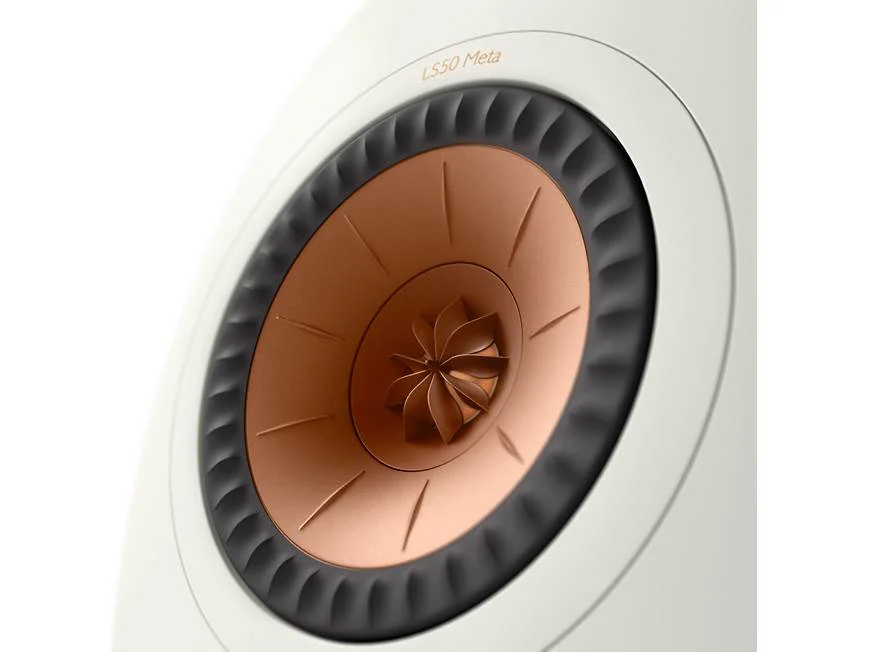
In 1988 the engineers at KEF created the Uni-Q driver, a coincident source point driver intended to enlarge the optimum listening area, allowing everyone sitting at different spots in the room to experience the same natural, detailed sound. Then in 2012, as a 50th anniversary celebration, the KEF LS50 was born and quickly became a legend. The LS50 uses a five-inch Uni-Q driver mounted in the center of a beautifully curved cabinet. The cabinet is molded around the Uni-Q driver in a rounded fashion helping the sound radiate evenly across the front baffle without interference and hard edges.
The LS50 has evolved into its current model, the LS50 Meta for $1,600. Meta is short for Metamaterial Absorption Technology, that can absorb nearly all of the unwanted sound radiating from the rear of the driver. KEF describes the Metamaterial Absorption Technology as “a highly complex maze-like structure, where each of the intricate channels efficiently absorbs a range of specific frequencies. When combined, the channels act as an acoustic black hole, absorbing 99% of the unwanted sound, eliminating the resulting distortion and providing a purer, more natural acoustic performance.” To put it simply, the sound coming from the back of the driver (the tweeter, in this case) is funneled into the maze-like structure, where the 30 different tubes act as sound absorbers for different frequencies. Sound goes in, and virtually nothing comes back out.
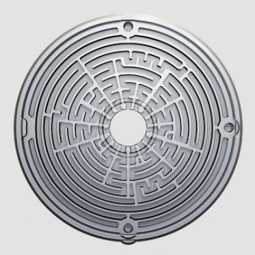
KEF’s Metamaterial Absorption Technology
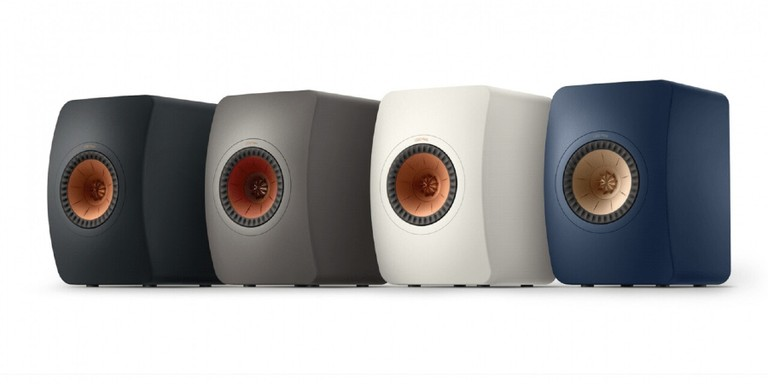
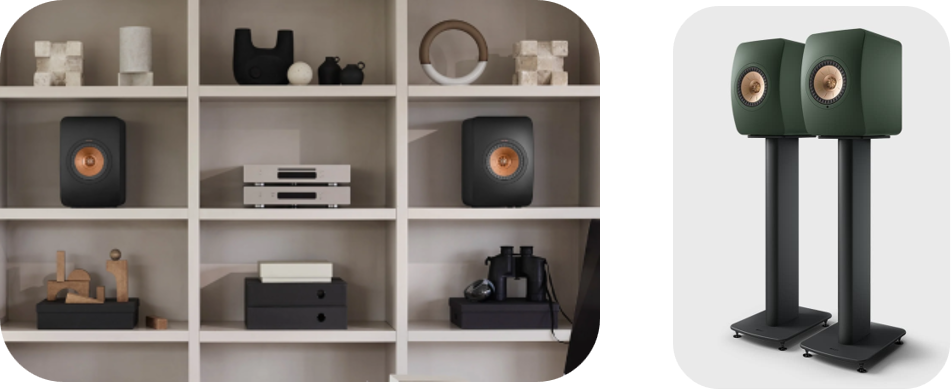
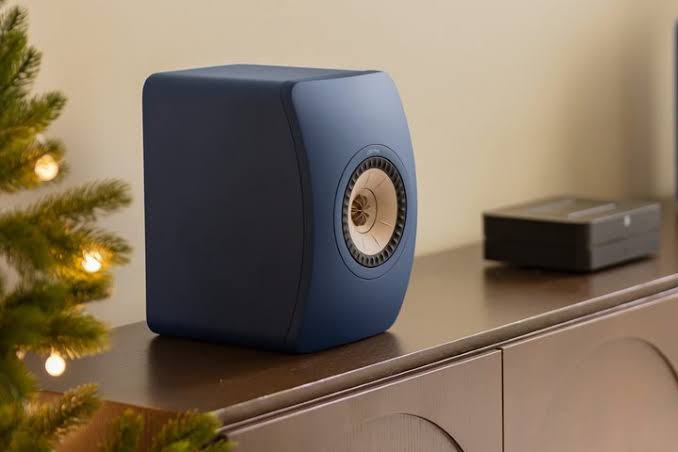
KEF offers four color options: carbon black, moss green, mineral white, and royal blue. They are a 2-way bass reflex design with a 5 ¼ inch mid-woofer and 1 inch metal tweeter mounted at the acoustical center of the mid-woofer acting as a single point source. They stand 12 inches tall by 8 inches wide and 13 inches deep and weigh 17 pounds each. There is a six-year warranty for these speakers if you register with KEF. There are no grills with these speakers. It would be shameful to cover the copper driver. For $3,000 KEF offers the LS50 Wireless II speaker.
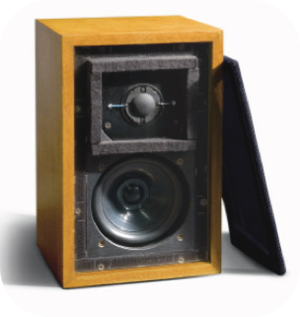
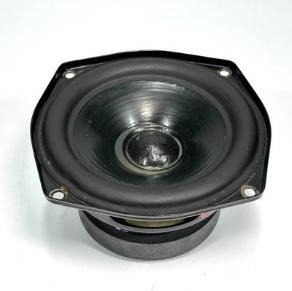
The original BBC Ls3/5a monitor speaker and the KEF B110 woofer from 1967.
Setup and Review System
In my room (measuring at 14’ D, 12’ W, and 9’ H and built on a wood foundation), I have the LS50 Metas four feet from the rear wall and seven feet apart. Two RELs T/9X subwoofers sitting beside each LS50 to the inside. The monitors sit on my 24-inch Target steel stands. KEF offers a stand designed for the LS50 with the following color options: carbon black, mineral white, royal blue, and crimson red. The KEF stand will cost you $500 and fit the LS50’s design much more visually appealing than my dull black stands. My wife complains about my stands because they never cool clean, regardless of any solvent or elbow grease. Because the LS50 Meta is an absolute beauty, the KEF stands are a worthy investment.
The rest of the system consists of two Schiit Tyr monoblocks providing 250 watts to each speaker. The Metas are 8-ohm speakers with a sensitivity rating of 85db, which is typical for a small speaker. Two REL T/9X subwoofers flank each Meta to the inside. The subwoofers are playing all frequencies below 70 hertz. Streaming is sourced from Qoboz through my NAD C 658 DAC/Streamer/Pre-amplifier. Speaker cables and XLR interconnects are from Benchmark. Power cables are Nordost Blue Heaven. The system with the KEF LS50 Metas costs $11,300.
Listening to Music
Gojira | Drum Solo
I didn’t want to use the clique of “good for its size” so I called in the big guns. I am not a fan of describing a speaker’s performance with a condition. I’ll mention the tradeoffs by using a small speaker or a large ribbon panel, but I won’t say it’s “good for the money or surprising bass for its size.”
Before jumping into any serious listening, I played the LS50 Metas overnight to break in. You should break your new speakers in before cranking them. It can’t hurt so do it! After shutting the loud air-conditioner, I plopped into my leather recliner close to the rear wall. My room is not big enough to pull the chair away from the back wall. With my eyes locked onto the NAD’s front panel’s display, I carefully increased the volume as the track progressed. My comfort zone ends once I see 75 on the NAD’s display. In the beginning I played the LS50s at full range and crept up to the 75-volume mark and the LS50s had enough. The sound became too congested as I demanded too much from the speakers. This track is loud and demanding and I exceeded any practical volume levels. I doubt most listeners would play this track as loud as I had it so this shouldn’t be considered a deal-breaker. Next, I limited the frequencies going to the KEFs above 70 hertz and relied on my two RELs to fill in the bottom-end. With that in place, I quickly went back to the high-volume danger zone (about 100db) and didn’t hear that same congestion and struggle. The kick drums stayed in their space and provided a goosebump impact throughout the room. To be fair to my RELs, they contributed more than the LS50s in this frequency band. But the snare hits sit in the speaker’s domain and the LS50s kept up with the RELs very well (I wanted to say perfect, but I need to leave room for when I hear perfection). The snares were quick, taught, and sounded just like a drum at a live event from the fifth row. The drum kit was right there spanning between my speakers with each drum in its own space. The LS50 Meta on its own was snappy and non-fatiguing but for this type of music and loud listening levels, a subwoofer is essential.
Rebecca Pidgeon | Spanish Harlem
Monitor-sized speakers typically have an image and soundstage advantage at the expense of low frequency impact. That’s not always the case. Having listened to Rebecca Pidgeon’s Spanish Harlem track for 20 years on many different systems I’ve heard what is possible. My best experience with this track was when I dropped in the Scott Walker room at Axpona audio show in 2024 and I was lucky enough to get a middle seat. The room moderator played this track upon my request. The room was quiet and dark, then I shut my eyes for a good listen. Rebecca’s warm seductive voice was straight in front of me about five feet from the floor and well beyond the speakers. The space around the singer was obvious and I could pick up all the nuances in her tone. The speakers playing were the seven-foot tall Estelon Extreme MKII with a cost of $340,000. With that as my reference, I hit the play button on my NAD and listened to Spanish Harlem through the Metas. Rebecca was in the same spot in the middle but closer to me and only about four feet from the floor. She had a nice space around her but not like the Estelons, an unfair comparison but I wanted to share the differences. To level the playing field I put my Magnepan LRS+ panel speakers ($1,500) into the same system and closed my eyes. The Maggies presented a thinner image, almost incomplete. I love the Maggies mostly because they scale much bigger than they are giving me a wall of sound. The KEFs don’t do that. They scale a little bigger than they are and aren’t as wide or deep. The KEFs gave me a more complete image as opposed to a flat wall of sound. Rebecca sounded fuller and more human.
The nuances in her voice were there, and her seductive rich voice was tugging at my heart. KEF’s LS50 Meta’s provide a very neutral tone in my review system and maintained the same levels when I used my NAD M10 V2 streaming amplifier. The KEF has a one-inch metal tweeter and never sounded harsh or bright. The speaker’s build quality is unmatched in my world, and they play as if they know it. It’s a sense I get when a speaker is playing with ease. The LS50s make me love this song.
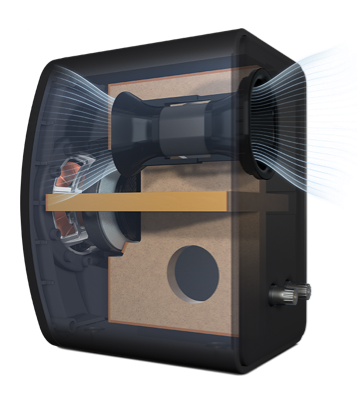
Inside view of the KEF LS50 Meta loudspeaker.
Ray LaMontagne | This Love Is Over

Ray’s voice on this track is fat and forward and during certain passages, he should sound like he’s sitting in front of you. A good system will have you reaching for the tissues. With the LS50 Metas, Ray’s voice appeared right in front of me larger than life. The KEFs were able to put a large holographic sphere in between the speakers and not beyond. The KEFs tonal character was able to pick up the emotion in Ray’s voice during the chorus – a difficult task only a confident speaker can deliver. As a comparison, I put the Maggie’s back in. The Maggies provided a larger image that was a little further back in the stage. Again, the LS50 Metas were fuller thicker sounding and an overall narrower and lower soundstage.
Stone Temple Pilots | Dead & Bloated

This is a great song to evaluate the dynamics of a system. At the start of Dead & Bloated, Scott Weiland sings through a mega horn, and your system should resolve that easily. The snare strikes following the mega horn should sound like a lighting bolt crack in between your speakers. The drum strikes should come across with high energy and a natural tone. Listening at about 90 decibels, the LS50s threw the snare crack dead center right at the speaker’s height. Partnered with a pair of good subwoofers, these KEFs can rock out with anything I’ve had in my room, except the Klipsch Heresy III.
Final Thoughts
I thoroughly enjoyed every second I had with the KEF LS50 Metas. These speakers have museum quality looks and construction. If I didn’t know the price I’d guess they cost $3,500. I have three other stand mount speakers and own quality stands that work well with each but if I didn’t, I would buy the KEF stands at $500. The LS50s look and sound so good it would be a shame to not have them sitting on their respective KEF stands. These monitors are physically small and work well in most small to medium-sized rooms. Like the original BBC LS3/5A, the KEF LS50 Meta is a legendary speaker and will be forever sought after. I purchased the review pair to use as my reference monitor for under $3,500. I can’t recommend the LS50 Meta enough.
Our recommendations reflect our personal experience with the equipment reviewed and should be considered alongside your own listening preferences and room acoustics. We encourage readers to audition audio equipment whenever possible. Great sound is personal, and the best component is the one that brings you closer to your music.
