



Adding a record player to your system adds incremental joy to the hobby. You can head to the record store digging through crates or use it as a reason to stop at garage sales. Collecting records can be a nostalgic trip back to high school. I think it adds sophistication to listening to your system. You are kind of forced to listen to the entire album in the order the artist intended.
Records don’t have to be expensive because the used market is just as big as new releases. A used album in good shape can cost as little as $8.00 versus a $30.00 newly released album. I tend to favor a new album because I enjoy hearing the crackling sound, opening the jacket, and I love the smell.
By adding a turntable to your system, you’re committing to a little manual labor. First off, you must physically drop the record on the turntable, dust it off, and lower the stylus. Then you should maintain and store your records appropriately. Standing the records on a shelf is better than stacking them as it avoids that circular crease on the album jacket.
The turntable isn’t like a CD player or amplifier. For best performance, it needs to be isolated from any vibrations. The turntable comes with absorption feet but pay attention to the shelf it’s on. Ideally you want to protect it from vibrations by using spikes on the risers holding the shelf. If you’re up for it add a sheet of Dynamat to the bottom of the shelf – you won’t notice it nor be able to remove it.
I’m hoping this guide removes any reluctance to add a turntable to your stereo. I’ll walk you through a brief anatomy of a turntable which will be helpful for troubleshooting or upgrading down the road. Then I’ll point out the types of turntables and cartridges. Finally, instructions to hook it up.
Identifying the Turntable Parts
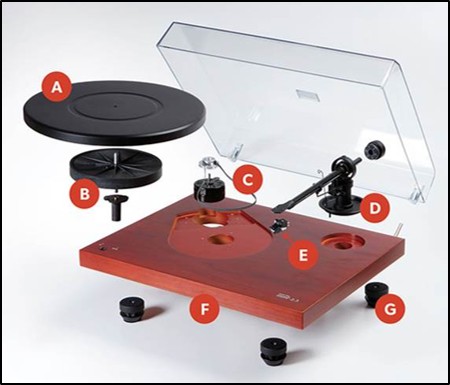
A. Platter: this is where the record sits
B. Spindle and bearing: ensures smooth platter rotation
C. Motor and pulley: this provides the torque that turns the platter, only found on belt-driven machines
D. Tonearm: built using lightweight and strong materials like aluminum or carbon fiber, tracks the record groove
E. Cartridge: the needle or stylus is housed here, and along with the coil and magnets inside, it converts the kinetic energy from the record groove into electrical signals
F. Plinth: provides a stable, resonance-free base
G. Feet: absorb vibrations avoiding skip-inducing rumble from speakers or movement in the room
Each part plays a critical role in record playback. Starting with the feet supporting the turntable. These are important because without them the record will skip every time you walk by it or strong bass not coming from your speakers. These should be designed to absorb rumbles in the room, so the record doesn’t skip. There are many options for upgrading the feet. If your turntable is well built by a reputable manufacturer, you should be fine.
The plinth or base of the turntable is a heavy wooden or strong composite material and work with the feet to minimize vibration. The plinth is not an upgradable part. Much of the turntable aesthetics come from the plinth.
The cartridge holds the stylus or needle. There are two types of cartridges: moving magnet (MM) and are typically found on less expensive record players, although not always, and moving coil (MC). Both are responsible for picking up the music located within the grove on the record. Upgrades range from $75 to $14,000.
The tonearm is that long skinny pole that holds the cartridge on one end and a counterweight on the other. Audiophiles have been known to upgrade their tonearms for lighter and/or better tracking arms, usually at a steep cost.
The spindle sits within the plinth and is responsible for spinning the platter. These can be belt-driven or direct drive. Here are the descriptions for each:
Types of Turntables
- Direct-drive turntables spin with precision. The platter hits full speed almost instantly and keeps things ultra-steady and consistent, which cuts down on “wow and flutter” (more on that later). Also, when the motor’s off, the platter spins freely, forward or backward, making this type of turntable ideal for DJs who take advantage of that feature for cueing and scratching.
- Belt-drive turntables on the other hand, use an elastic belt to spin the platter, which helps keep motor noise out of the mix. That bit of isolation can give your music a warmer, more detailed sound. Some audiophiles swear it’s the best way to hear every nuance in a recording.
The platter holds the record and should be designed to minimize vibrations. Some record players include a dust cover while many don’t. Adding an aftermarket cover isn’t cheap and it is harder to find one that matches the turntable’s design.
It’s good to be aware of at least some of this. Troubleshooting will be less frustrating and it’s interesting to understand the mechanics of your turntable. Your friends will be impressed.
Can I connect my turntable directly to my receiver or amplifier?
That depends on a few things. A turntable needs a step-up transformer before connecting to your amplifier. If your turntable has built-in step-up transformers then the answer is yes. If your receiver or amplifier is featured with an internal phono-preamplifier, then yes. If your turntable and receiver do not include a built-in phono-preamplifier, then the answer is no.
When neither has a built-in phono-preamplifier, you need to add a separate phono-preamplifier before you connect your turntable to your amplifier. They are readily available and relatively inexpensive, especially for a MM cartridge. If you have an MC cartridge you can expect to spend more. I’d recommend spending at least 20% of your turntable’s cost. Companies offering affordable phono-preamplifiers include Schiit Audio, Cambridge Audio, Pro-ject, Rega, among others. These same companies have a strong presence in the higher-end universe.
Time to hook up the turntable to the amplifier
Install your turntable on a sturdy shelf and do everything you’re willing to do to avoid vibration. After you find a home for your turntable it’s time to connect it to your system. Connect the RCAs from your turntable to the phono-preamplifier then connect to any line-in input on your amplifier with either RCA or XLR (balanced) cables. At this point, you’re ready to listen to your records.
Handle your records on the outside of the record to avoid fingerprints and grease. Treat them well.
Recommended Turntables
Here are a few recommended turntables from reputable manufacturers that will satisfy your analog itch. For turntables, I tend to suggest companies that are well known for making quality analog products. The analog market can be overwhelming with unfamiliar terminology, and this list will steer you to quality turntables and an easy transition to playing records.
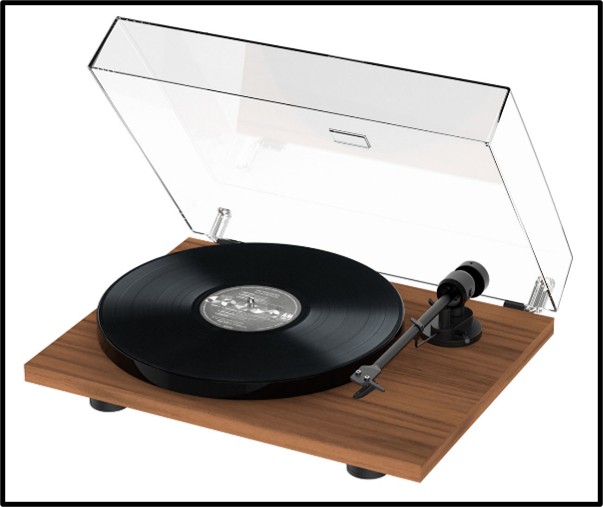
- Pro-Ject E1 Phono Plug & Play Turntable: $399
- Plug and play – easy to get started
- Built in phono-preamplifier
- Belt driven turntable
- Moving magnet cartridge
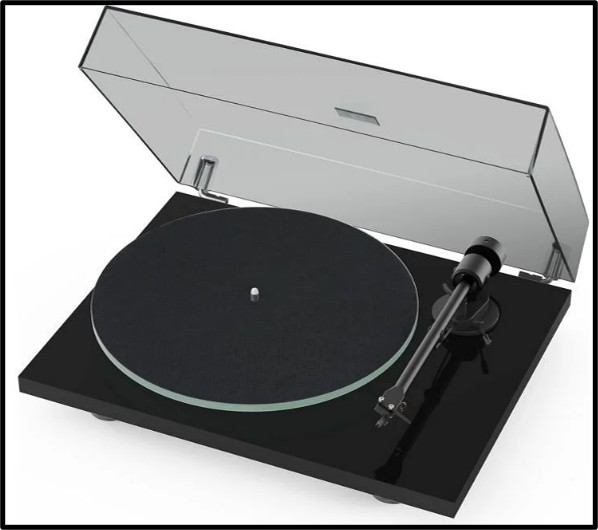
- Pro-Ject T1 EVO Phono: $599
- Moving magnet cartridge
- Built in phono-preamplifier
- Manual operation
- Belt driven turntable
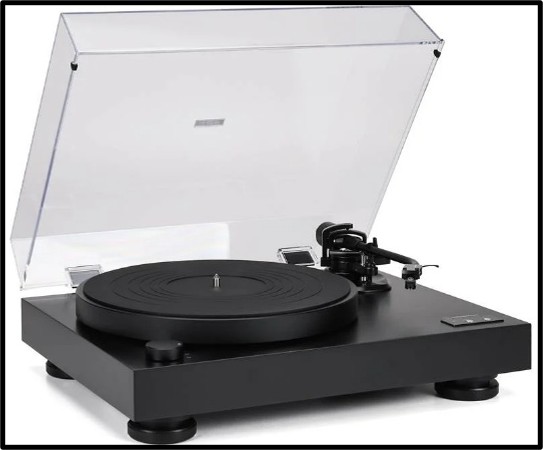
- Audio-Technica AT-LP8X: $1,299
- Semi-automatic operation
- Moving magnet cartridge
- Direct-drive turntable
- Requires amplifier with phono input or a separate phono-preamplifier
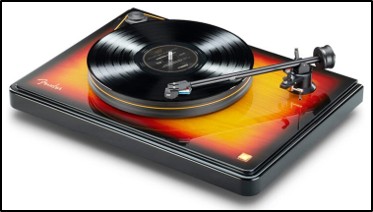
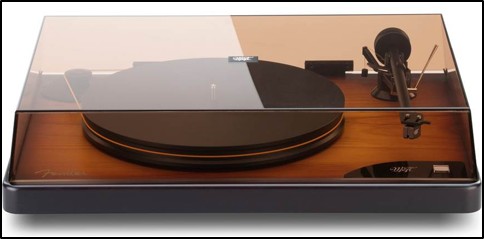
- MoFi Electronics Fender Turntable: $2,999
- Moving coil cartridge
- Plinth finished by Fender
- Manual operation
- Belt driven
- Includes dust cover
Our recommendations reflect our personal experience with the equipment reviewed and should be considered alongside your own listening preferences and room acoustics. We encourage readers to audition audio equipment whenever possible. Great sound is personal, and the best component is the one that brings you closer to your music.
